Article written by -AMALA THOTI
TITLE
"Minimalism vs. Maximalism"
Subtitle:
“Finding the Right Visual Volume for Your Target Demographic”
Abstract:
In contemporary visual communication, design philosophies play a pivotal role in shaping user experience and brand perception. Minimalism and maximalism, representing two contrasting approaches, influence how audiences interact with digital and physical interfaces. This article examines the core principles of both styles, introduces the concept of visual volume, and analyzes their suitability across different demographic segments. It further provides a strategic framework for selecting and implementing the appropriate design approach.
Introduction:
The evolution of design in branding, UI/UX, and marketing has led to the emergence of two dominant visual philosophies: minimalism and maximalism. While minimalism advocates simplicity and clarity, maximalism emphasizes richness and expressive detail. These approaches are not merely aesthetic choices but strategic tools that impact user engagement, comprehension, and emotional response. Selecting the appropriate visual style requires a deep understanding of the target demographic and the intended communication objectives.
Conceptual Framework:
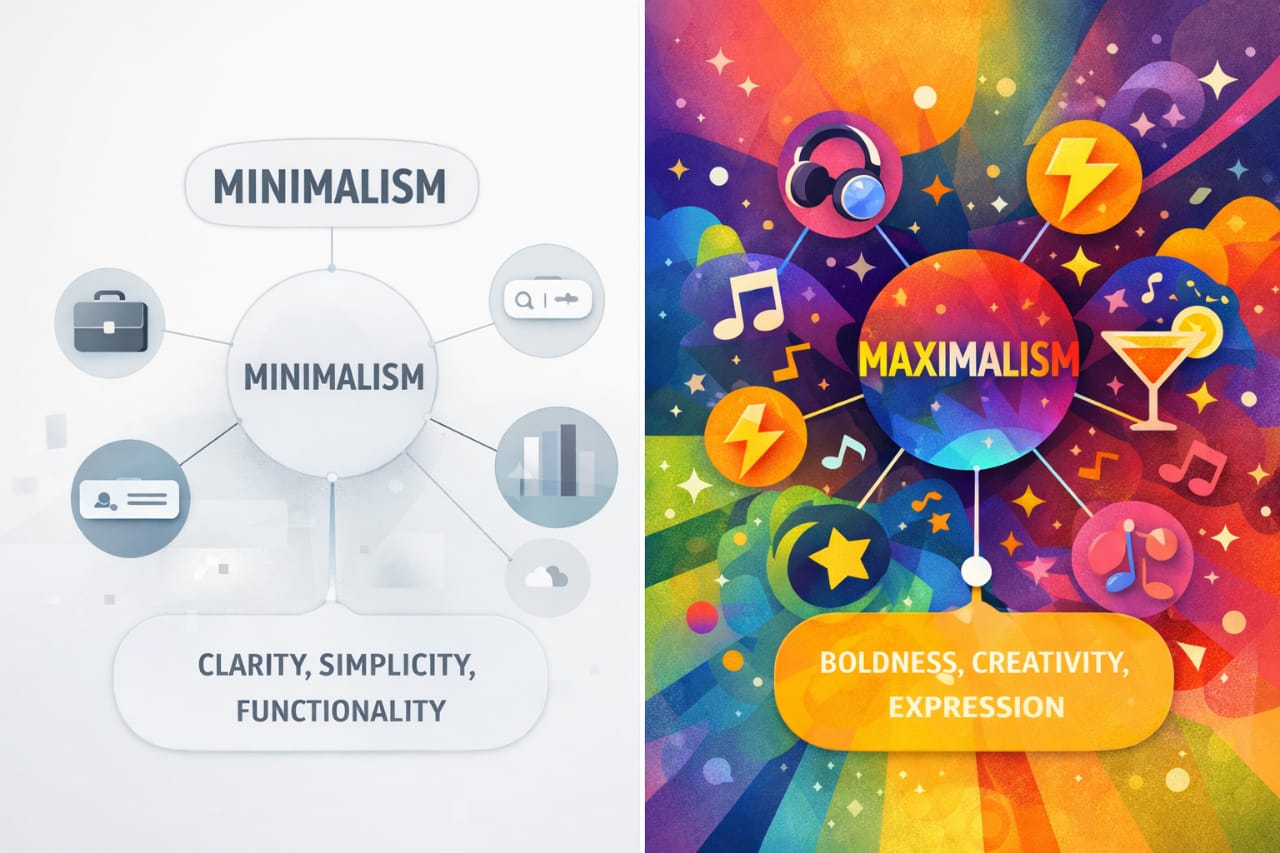
Minimalism: The Principle of Reduction
Minimalism is grounded in the idea of eliminating non-essential elements to enhance clarity and usability. It prioritizes function over form while maintaining aesthetic balance.
Key Features:
- Clean and structured layouts
- Extensive use of white space
- Limited and neutral color schemes
- Emphasis on essential content
A notable example is Google, whose homepage design reflects simplicity and efficiency. By reducing visual clutter, minimalism creates a low visual volume environment that supports quick cognition and decision-making.
Maximalism: The Principle of Expansion
Maximalism, in contrast, embraces abundance and visual richness. It leverages complexity to create immersive and emotionally engaging experiences.
Key Features:
- Vibrant and diverse color palettes
- Layered patterns and textures
- Bold typography and dynamic layouts
- High-density visual composition
Marketing campaigns by Spotify exemplify maximalism through their energetic and visually stimulating designs. This approach results in high visual volume, capturing attention and fostering emotional connections.
Visual Volume: A Critical Design Variable
Visual volume refers to the concentration and intensity of visual elements within a design. It serves as a key determinant of user perception and interaction.
Low Visual Volume:
Associated with minimalism, it enhances readability, reduces cognitive load, and facilitates quick decision-making.
High Visual Volume:
Associated with maximalism, it increases engagement, stimulates emotional response, and enhances memorability.
Understanding and controlling visual volume is essential for aligning design with user expectations and behavioral patterns.
Demographic Considerations
The effectiveness of a design approach is closely linked to the characteristics of its target audience.
Minimalism is most effective for:
- Corporate professionals
- Older demographics
- Luxury and premium consumers
- These groups typically value clarity, trustworthiness, and efficiency.
Maximalism is most effective for:
- Generation Z and millennials
- Creative communities
- Entertainment-oriented audiences
These segments are drawn to dynamic, expressive, and visually stimulating content.
“Strategic Implementation”
1. Audience Analysis
A thorough understanding of user demographics—including age, preferences, and digital behavior—is fundamental to design selection.
2. Purpose Alignment
Design must align with functional objectives:
- Minimalism suits productivity tools, financial platforms, and professional services.
- Maximalism is ideal for fashion, entertainment, and social media platforms.
3. Hybrid Design Approach
Contemporary design practices increasingly favor a hybrid model that integrates both philosophies:
- Minimalist structures ensure clarity and usability.
- Maximalist elements introduce engagement and visual interest.
For instance, a website may adopt a clean homepage while incorporating vibrant and interactive elements on internal pages.
4. Performance Evaluation
Data-driven techniques such as A/B testing enable designers to evaluate effectiveness based on engagement metrics, click-through rates, and user preferences.
Conclusion
Minimalism and maximalism represent two powerful yet contrasting design strategies. Their effectiveness depends not on their inherent superiority but on their alignment with audience expectations and communication goals. By understanding visual volume and applying a strategic approach, designers can create experiences that are both functional and engaging. In many cases, a balanced integration of both styles yields optimal results.
Final Insight
“The success of a design lies not in its complexity or simplicity, but in its ability to resonate with its intended audience.”
Key Takeaway
- Minimalism enhances clarity and speed of understanding
- Maximalism strengthens emotional engagement and visual impact
- AMALA THOTI(MMM)